Description
With the splitter pattern, a given message can be split into fragments. Each fragment is processed hereinafter by a single process instance. The splitting and the following processing is defined within in the same process model.
Create
-
Create a process model
-
Open the panel named process, per default this panel is on the right side of the Orchestra designer window.
-
Click on the folder activities to see its content.
-
on "Splitter" and drag it to any place in your process model.
Icon

Configuration
Label and Non functional properties
See at common configurations for activities.
Splitting
In this tab all settings how splittings works are done.
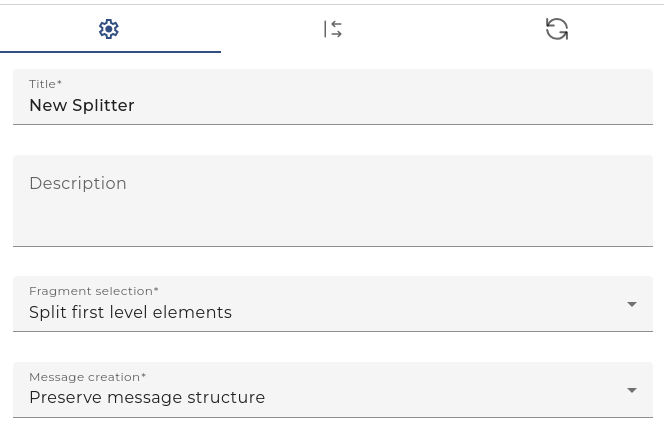
| Field | Description |
|---|---|
| Fragment selection | Defines how a message should be split into fragments Split first level elements: All elements on the first level of the message are split into single pieces. Use path selection: A simplified path expression that is used to select the result elements. |
| Selection | Defines a simplified path expression that is used to select the message fragments A path expression is a repeated sequence of path-fragments, e.g., /elementA/elementB. This selection searches for all elements with the name elementB that exist within an element with the name elementA. If * is used, all element names match. Note: The simplified path selector ignores namespaces.Also, a limited version of a recursive descent operator can be used. This allows getting all elements of the same name independent of the nesting. The path has to look like //element(/fragment)*. |
| Message creation | Defines how the result messages are generated from the fragments Use split element: The fragment itself is used to generate an orchestra message. This means that an orchestra message is created with the fragment as it is. Preserve message structure: The created orchestra message has the same structure as the original message, but it contains only the fragment and the parent elements up to the root of the original message. In both cases, the namespaces of the original message are preserved. |